
Types of Recliners: Every Style Explained (With Sizes)
Every recliner type compared in one table — rocker, wall hugger, swivel, zero gravity, lift — plus typical sizes, clearance needs, and who each style fits.
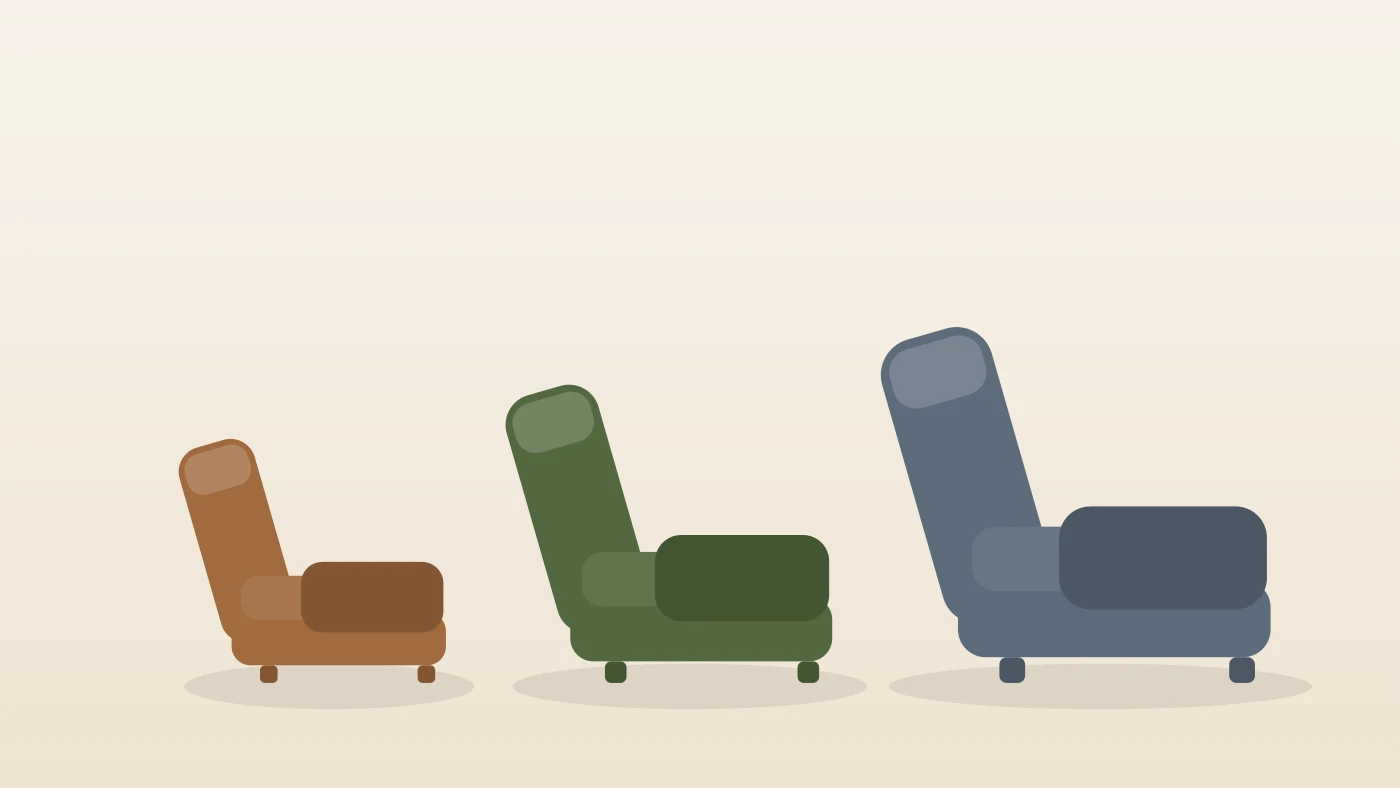
There are about ten types of recliners, and the differences that matter are mechanical, not cosmetic: how the chair reclines, how much wall space it needs, and how much body it’s built to hold. This hub explains every type, gives typical sizes for each, and points you to our measured picks in each category.
What are the main types of recliners?
The master table below compares every core type on the two specs that cause the most buying mistakes — width and wall clearance — plus who each type suits best.
| Type | Best for | Typical width | Wall clearance | Our guide |
|---|---|---|---|---|
| Standard two-position | Budget buyers, occasional use | 30–36 in | 12–18 in | Best TV recliners |
| Rocker recliner | Nurseries, restless sitters | 32–38 in | 12–18 in | Rocker recliner picks |
| Wall hugger | Small rooms, apartments | 28–35 in | 4–6 in | Wall hugger clearance data |
| Swivel recliner | Corner placement, conversation areas | 28–34 in | Base-dependent | Swivel recliner picks |
| Power recliner | Anyone who dislikes lever effort | 32–40 in | 4–18 in | Power vs manual compared |
| Lift chair | Sitters who struggle to stand up | 30–38 in | 6–24 in | Lift chair guide |
| Zero gravity | Full-body pressure-spread recline | 30–38 in | Model-dependent | Zero gravity explained |
| Lay-flat | Nappers, near-180° recline | 32–40 in | 10–20 in | True lay-flat picks |
| Oversized | Broad builds, sprawlers, chair-sharers | 38–50 in | 12–18 in | Oversized recliners measured |
| Heat & massage | Feature-first comfort buyers | 32–40 in | Model-dependent | Heat & massage reality check |
Ranges reflect published specs across major brands; always check the listed spec for the exact model you’re buying, and see our recliner dimensions guide for how to measure your space.
How does a standard recliner differ from a rocker or glider?
A standard two-position recliner only leans back and pops the footrest — the base never moves. A rocker recliner adds an arched rocking motion when upright, which is why rocker recliners dominate nurseries. Gliders move on a linear track instead of an arc, giving a flatter, quieter motion.
Rocking bases add moving parts, so they’re slightly more failure-prone than fixed bases. If a chair you own has already developed problems, our recliner repair hub matches symptoms to fixes.
Which recliner type saves the most space?
Wall huggers, by a wide margin. A standard mechanism pivots the backrest into the space behind the chair and typically needs 12–18 inches of wall clearance; a wall hugger recliner slides the seat forward as you recline and often needs only 4–6 inches.
Three related small-space plays: compact recliners for apartments shrink the whole footprint, swivel recliners tuck into corners because they rotate instead of relocating, and RV recliners and wall huggers for campers are built for the tightest rooms of all.
Should you get power or manual?
Manual if you want fewer failure points and no cords; power if you want effortless, precise positioning. Power models add motors, a transformer, and often USB ports and adjustable headrests — and they stop working when those parts do. Our full power vs manual recliner comparison breaks down cost, reliability, and who genuinely benefits from each.
One placement note: power recliners need an outlet, which constrains where the chair can live in the room.
Which recliners recline flat or near-flat?
Three types get you horizontal or close to it:
- Lay-flat recliners open to a true or near-true 180°, the closest a chair gets to a bed.
- Zero gravity recliners stop around a reclined posture with legs raised near chest level, spreading your weight across the whole chair.
- Bed recliners are built specifically to double as sleeping furniture.
If you’re considering any of these because you plan to sleep in the chair regularly, read our guide to sleeping in a recliner first — seat depth and recline angle decide whether that’s comfortable or miserable.
What if you’re bigger or taller than average?
Buy by weight rating and seat dimensions, not by the word “large” in a product name. Standard recliners are typically rated to 250–300 lb with seats 17–22 inches wide. Beyond that:
- Oversized recliners widen the seat to roughly 22–26 inches.
- Big and tall recliners combine wider seats with taller backs and higher ratings.
- Heavy-duty 400 and 500 lb recliners use reinforced mechanisms — the rating is the spec to verify, not assume.
- Recliners for tall people solve the opposite problem: headrests that hit 6’2”+ sitters in the neck and footrests that end mid-calf.
Which type is easiest for seniors?
For ease of getting in and out, the ranking is: lift chair, then a firm chair with a higher seat, then power recline. A lift chair’s entire frame tilts up and forward to help you stand — our lift chair guide explains 2-position vs 3-position vs infinite-position models. If a full lift chair is more than you need, our easiest recliners for seniors round-up focuses on seat height and simple controls.
What styles do recliners come in?
Every mechanism above comes wrapped in multiple looks. The style pages below are curated picks that still recline properly — style-first chairs often sacrifice mechanism quality, and we filter those out:
- Mid-century modern recliners — tapered legs, low profiles
- Mission style recliners — exposed wood arms
- Leather wingback recliners — traditional high backs
- Velvet recliners — soft-fabric statement chairs
- Leather recliners — grades, colors, and which hides last, plus color-specific picks in blue, red, and white leather
- Camo recliners — the full round-up
- Outdoor recliners — weather-rated frames and replacement cushions
If your problem is an ugly-but-functional chair you already own, recliner covers that actually stay on are the cheap fix.
Which brands should you look at?
Start with brands that publish real specs and sell replacement parts. We’ve reviewed the major names: Catnapper, Bradington-Young, Southern Motion, and HomeStretch. If you’re eyeing the biggest name of all, read known La-Z-Boy recliner problems before paying the premium.
Buying in November? Our Black Friday recliner deals tracker follows real discounts on chairs we’ve vetted.
Who should NOT buy a recliner at all?
- You need seating for a shared wall-to-wall media room. A reclining sofa or sectional uses the space better than a row of chairs.
- Your room can’t give up front clearance. Every recliner needs roughly 2 feet in front for the footrest, even wall huggers.
- You move frequently. Recliners are heavy and awkward through doorways; a standard armchair plus ottoman travels far better.
- You want a chair a rocker-loving cat or toddler can’t tip. Rocking and swivel bases are the wrong choice around climbing kids.
Frequently asked questions
Quick answers to what buyers ask us most
What is the most popular type of recliner?
The standard two-position rocker recliner remains the volume seller in the US, because it's the cheapest way to get both motions. Power wall huggers are the fastest-growing segment, driven by smaller rooms and the falling price gap between manual and power mechanisms.
What's the difference between a recliner and a lift chair?
A lift chair contains a motorized mechanism that tilts the entire chair up and forward to help you stand, on top of normal recline functions. A regular power recliner only changes the backrest and footrest. Lift chairs cost more and need more rear clearance in most configurations.
Which recliner type is most reliable?
Manual chairs with simple two-position mechanisms have the fewest failure points — no motors, transformers, or hand wands. Among power chairs, models from brands that sell replacement parts are the safer bet, because the most common failures (transformers, cables, springs) are cheap to fix when parts exist.
Can one recliner type do everything?
An infinite-position power lift chair comes closest: it reclines near-flat, raises legs independently, and helps you stand. The trade-offs are price, bulk, and needing an outlet. For most buyers, matching one type to your main use case beats paying for positions you'll never use.
How much should a good recliner cost?
Serviceable manual recliners start under $500. The $800–$1,200 band buys name-brand mechanisms, better foam, and real warranties. Above $1,500 you're paying for premium leather, made-to-order builds, or advanced lift and massage hardware — worth it for daily multi-hour sitters, unnecessary for occasional use.